School of Ports and Terminal Management 4
February 13, 2024 2024-06-21 7:50School of Ports and Terminal Management 4
About
Director's Desk
Achivement
Events
Faculties
FAQ'S
Features
Placement
Testimonials
Program
About
The world has started to witness the penalty for unsustainable lifestyles and patterns of production and consumption. As the human population is exploding, resources are shrinking.
Concerns loom everywhere, from declining pollinators affecting food security to air and water pollution affecting the quality of life, and land shortage and degradation affecting both agriculture and biodiversity.
These are just some examples of the results of unsustainability. This is an important moment to find solutions for sustainable living, in harmony with Mother Earth.
India is home to one-sixth of the world’s people and it has the densest population. It also has the second-largest population after China, which it will surpass in less than a decade if current trends continue. India is a country full of diversity and contradictions. While per-capita emissions are amongst the lowest in the world, it is also the third biggest generator of emissions. Despite being the third-largest economy in the world, India also has the largest number of people living below the international poverty line. Because of this sheer size and rapid growth, sustainability is a challenge. In spite of these challenges, India is a conscious aspirant. It has shown leadership in combating climate change and meeting the Sustainable Developmental Goals (SDGs), as is reflected in many of its developmental schemes. India is one of the least wasteful economies.
It has frequently been acknowledged by stakeholders for its cooperation and efforts to promote climate change mitigation, and environmental sustainability; this has been through policy measures, dialogue facilitation between nations, and taking decisive steps, especially after India emerged as a key player in shaping the Paris Agreement, along with adopting energy-efficiency measures. There is no alternative to sustainable development. While Indian culture has the ethos for sustainable management of natural resources– namely, reuse, reduce, and recycle. Sustainability has always been a core component of Indian culture. Its philosophy and values have underscored a sustainable way of life. Since India is committed to sustainable development as an agreed goal of the UN, every sector is trying to internalize the practice of sustainability.
Youngsters should be involved because their future is critically at stake, with global warming and climate change knocking at the door.
India is strongly committed to the Sustainable Development Goals (2030), wherein most goals directly or indirectly are linked with natural resources and their sustainable management. In order to understand and implement these goals, there is an increasing need for experts in natural resources and sustainability. India’s National Action Plan on Climate Change (NAPCC) has eight missions that can be implemented in a consultative manner by engaging multi-stakeholder groups such as experts from industry, academia, and civil society. With the introduction of CSR, corporates are involved in activities such as education, health, environmental sustainability, gender equality, and vocational skills development. Transition to a greener economy has tremendous employment Potential of creating millions of jobs directly & indirectly.
Youngsters should be involved because their future is critiHence, we need more experts and skilled professionals in environmental sustainability, particularly in sustainability reporting. The skills mismatch is identified as the key obstacle to building an environmentally sustainable & low carbon economy. The right skills need to be incorporated into education to support an environmentally sustainable Economy. The education in the domain needs to be combined with hands-on experience. Symbiosis Skills & Professional University (SSPU), Pune, is Maharashtra’s first skill development university established with a vision to provide skill-based education in high-growth sectors. SSPU has been enacted under the Government of Maharashtra Act in 2017. It is set up on a sprawling sustainable campus located near Pune. The unique feature of this University is the Centre of Excellence and Learning factories established in collaboration with top industries.cally at stake, with global warming and climate change knocking at the door.
Youngsters should be involved because their future is critiHence, we need more experts and skilled professionals in environmental sustainability, particularly in sustainability reporting. The skills mismatch is identified as the key obstacle to building an environmentally sustainable & low carbon economy. The right skills need to be incorporated into education to support an environmentally sustainable Economy. The education in the domain needs to be combined with hands-on experience. Symbiosis Skills & Professional University (SSPU), Pune, is Maharashtra’s first skill development university established with a vision to provide skill-based education in high-growth sectors. SSPU has been enacted under the Government of Maharashtra Act in 2017. It is set up on a sprawling sustainable campus located near Pune.
The unique feature of this University is the Centre of Excellence and Learning factories established in collaboration with top industries.cally at stake, with global warming and climate change knocking at the door.
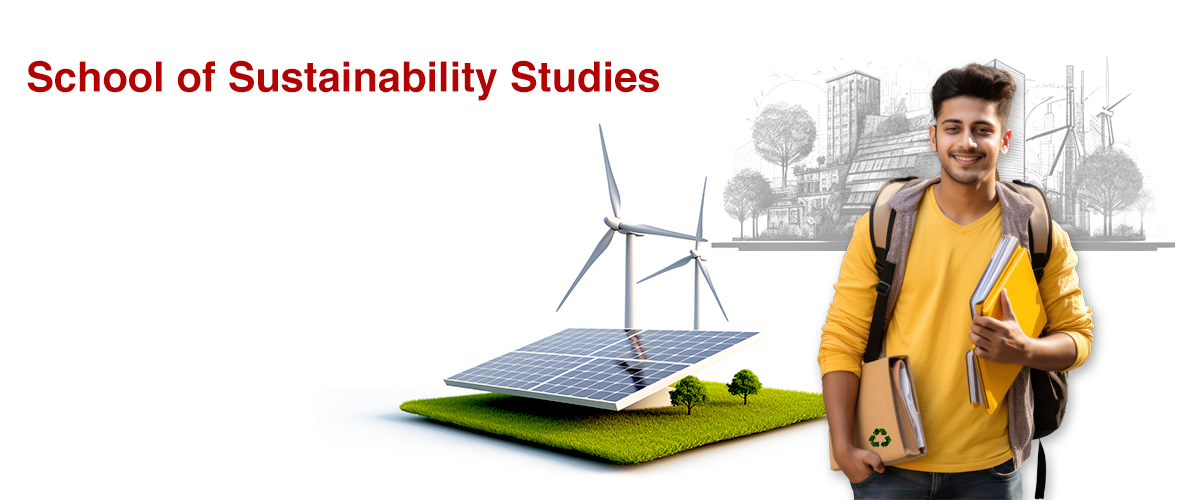
Symbiosis Skills and Professional University established a School of Sustainability Studies to cater to the same need. The skilled professional of this school will have research and career opportunities in following domain
Renewable Energy
Climate change and Environmental science
Energy Conservation and Energy Audit
Energy Efficiency and Energy Management
Sustainable and Green Transport
Sustainable and Green Construction
Energy Storage
Smart and Eco-friendly Materials
Energy Economics and Finance
Energy Data Analytics
Energy Policy and Regulations
Smart Grids
Energy and Power Transmission
Entrepreneurship in Energy Sector
Director's Desk
Director's Desk
The Automotive Industry is an ever-growing sector, with emphasis on electrified and autonomous vehicles, Emissions and Environmental Control, Lightweight Structures, High-Efficiency Powertrains, Intelligent Control Systems, Robust Design and Manufacturing, Improved Comfort and Safety. School of Automobile Engineering at Symbiosis Skills and Professional University, offer skilled based higher education for undergraduate students for sustainable development of Local & Global Automobile Industry.
Automotive engineers are expected to make connections among different areas of knowledge and integrate them for benefit of automotive industry, society and the environment. They must be expert in their own areas of specialty and also have a good understanding of the related disciplines, viz; skilled in synthesis, analysis and design, work effectively in a team environment, and adopt a ‘systems’ approach.
At the school of Automobile Engineering, SSPU we Provide skill-based quality education incorporating with latest and future trends in Automobile Industry. Enhancing student’s practical knowledge and employability through industry interaction through internships. Undertake research projects of Interest to Automobile Industry.
The curriculum for our skill-based B.Tech. Degree is crafted with the involvement of experts from automobile industries for inculcating technical knowledge and skills in a variety of topics which are beyond the scope of traditional engineering curricula.
The school has unique skill laboratories developed with industry support imparting skills for newer automotive technologies including CAD / CAM based product design, Hybrid and Electric Vehicles, Advanced Manufacturing, Electronics and Controls, Automation and Robotics, Industry 4.0 etc.
Many courses in this program are specifically designed to address the new and emerging technology in the automotive industry. Students in this program will not only learn about advanced technologies, but also how to apply them in practice for creative design and problem solving.
SSPU has created an engineering start-up ecosystem in the campus by establishing an Innovation and Incubation cell.
We also offer Diploma / Short term courses based on the Industry need for reskilling and upskilling of their workforce.
Achivement
Students from School of Automobile and Mechatronics Engineering Competed in SAE SUPRA competition held at Buddh International Circuit, Greater Noida, U.P from 10th to 13th July 2023
Mr. Kavish Shetty, a student of S.Y Automobile Engineering won the Gold Medal in Maharashtra State Shooting Competition held in August 2023.
Mr. Aridaman Singh Jalen , Final Year Automobile Engineering Students participate in National Online Electric Bike Design Competition Season-3 organized by Fraternity of Mechanical and Automotive Engineers
Mr. Tejas Rikame, Mr. Aditya Ringane, Mr. Omkar Shinde, Mr. Manish Gangurde, Mr. Nitesh Shenoy presented paper on “Numerical Analysis on Thermal Management of Lithium-Ion Battery Pack Used in Electric Vehicle for Performance Enhancement” at International Conference on Recent Advances in Fluid Mechanics and Nanoelectronics (ICRAFMN-2022), Manipal Institute of Technology Bengaluru

Events

Faculties

Our Most
Popular Teachers
Popular Teachers
Prof. Sumit Vasantrao Dubal
Prof. Rajkumar Baghel
Prof. Roshan Devidas Bhagat
FAQ'S
Frequently Asked Questions
What is your program's duration?
B.Sc. (Data Science) – 3 Year Program. However, after each year there is an internship module of 8 credits. The detail of internship is as under
2 months after second semester (During First year)
2 months after Fourth semester (During Second year)
6 months after fifth semester (During third year)
M.Sc. (Data Science – 2-year program
What courses can I use to meet the program's prerequisites?
It could be better if you come with a basic background of below mentioned subjects/Domains.
Computer Programming:
- Problem solving, analysis and design of small-scale computational systems, and implementation using a procedural programming language.
- Python is the language most utilized in our program, however students are able to apply with backgrounds in other languages.
Statistics:
- Parameter estimation, introduction to the collection of data, elements of probabilistic modelling, basic probability computation techniques, discrete and continuous random variables and distributions, expectation and variance, central limit theorem, single-parameter confidence interval estimation, and exposure to any statistical software package.
Calculus or Linear Algebra:
- Calculus: single variable calculus, limits, derivatives and integrals of algebraic exponential, logarithmic and trigonometric functions play a central role, applications of differentiation, and fundamental theorem of calculus.
Linear Algebra: systems of linear equations, matrix algebra, linear transformations, and determinants.
Does M.Sc. (Data Science) have thesis component.
Yes, In the final year (4th semester) a thesis must be submitted along with one research paper published in web of science/Scopus indexed journal/conference.
Features
Features
Placement
Accordion #1
Lorem ipsum dolor sit amet, consectetur adipiscing elit. Ut elit tellus, luctus nec ullamcorper mattis, pulvinar dapibus leo.
Accordion #2
Lorem ipsum dolor sit amet, consectetur adipiscing elit. Ut elit tellus, luctus nec ullamcorper mattis, pulvinar dapibus leo.
Accordion #3
Lorem ipsum dolor sit amet, consectetur adipiscing elit. Ut elit tellus, luctus nec ullamcorper mattis, pulvinar dapibus leo.
Testimonials
Testimonail
My journey as a student of B.Sc. Data Science by far has enabled me to implement various skills in real-life scenarios thanks to the hands-on, practical approach to teaching by our highly qualified professors. We are given various projects and assignments along with continuous assessments for self-evaluation and tracking our progress.
Yutika Rege
Program: B.Sc. in Data Science
“My life at Symbiosis Skills And Professional University made me stronger and took me a step ahead for being an independent woman. I am thankful to all the teachers who supported us and corrected us throughout our semester. I loved the infrastructure of the University and its International life.
Gritika Pardeshi
Program: B.Sc. in Data Science
“Absolutely fantastic place to study. Lovely friendly staff that is always on hand to help if you have any problems. The staff is more than qualified to teach lessons. Staff is great if you need anyone to help. I feel safe whilst I’m studying both in and around campus.
Sahil Pansare Batch of 2019 - 20
Program: B.Sc. in Data Science
“My experience at the School of Data Science at Symbiosis Skills and Professional University has been one to cherish and learn from. Given the university is young and the conception of data science as a bachelor’s degree has been newly founded, the course has gradually evolved and become better and more practical as each term passes. The degree encapsulates a thorough array of interdisciplinary modules from foundational mathematics to programming and big data to machine learning.
Suryajiraje Deepak Bhosale
Program: B.Sc. in Data Science
“My experience at the School of Data Science at Symbiosis Skills and Professional University has been one to cherish and learn from. Given the university is young and the conception of data science as a bachelor’s degree has been newly founded, the course has gradually evolved and become better and more practical as each term passes. The degree encapsulates a thorough array of interdisciplinary modules from foundational mathematics to programming and big data to machine learning.
Suryajiraje Deepak Bhosale
Program: B.Sc. in Data Science Program
1
Graduated Students
1
Placed Students