School
February 6, 2024 2024-02-07 6:37School
“Tell Me and I Forget; Teach Me and I May Remember; Involve Me and I Learn”
This is the Philosophy of Symbiosis School of Architecture, Urban Development and Planning (SSAUDP), which was established in 2017 in order to focus on skill-based education in India. The aim of this department is to bridge the gap between industry and education. With its founding principles of academic excellence, hands-on practices, and research aimed at addressing real-world problems.
The idea of a multi-skilled architect exists since Vitruvian time, as architects used to play the role of master-builders. The complexity of Architectural Practice today requires professionals with a wide array of skillsets – for example, visualization, creative problem solving, computer drafting skills, communication skills, interpersonal skills, management skills, more importantly, multitasking skills and so on. However Architectural education today seems to focus just on graphical skills and form manipulation skills. Architecture though being a skills course in itself has come a long way from the conventional education system. Today an architect requires digital skills along with the traditional skills of sketching and drafting. These skill sets, although essential to design, envisage only a part of an Architect’s role in the practical contexts.
There is a high demand for architects with the skills and attributes needed to successfully manage different projects. Those skills attributes are not limited to planning and designing but extended to include a diverse set of employability skills or 21st Century Skills.
The International framework of 21st-century skills is divided into three skill sets and twelve components laid out.
Skill Set 1: Learning and Innovation with the components:
Critical thinking and problem solving, communication and collaboration, and creativity and innovation.
Skill Set 2: Digital Literacies with the components: information literacy, media literacy, and information and communication literacy.
Skill Set 3: Life and Career Skills with the components: flexibility and adaptability, initiative and self-direction, social and cross-cultural interaction, productivity and accountability, and leadership and responsibility.
The school focuses on learning by doing, which helps budding architects get involved in every single aspect of the field. The unique feature of the curriculum is the internship after every year, whereas in conventional colleges internships are conducted only in the fourth year. This kind of experiential learning opens up doors to a plethora of other fields that are in demand nationally and internationally.
The school has extensive contacts with government and trade organizations, private consultancies, different industries, and small and medium-sized companies. It also offers live workshops, webinars, and seminars with national and international eminent architects.
Also recognizing multiple intelligences and mapping the skillsets of the students is a very important aspect that is carried out diligently when the student is admitted. It helps the teachers commiserate with a variety of individual cognitive strengths, develop the skills of the students, help them to do multitasking, and implement varied tools to evaluate their skillsets. This also helps the students understanding their own potential and choose the right career for a bright future.
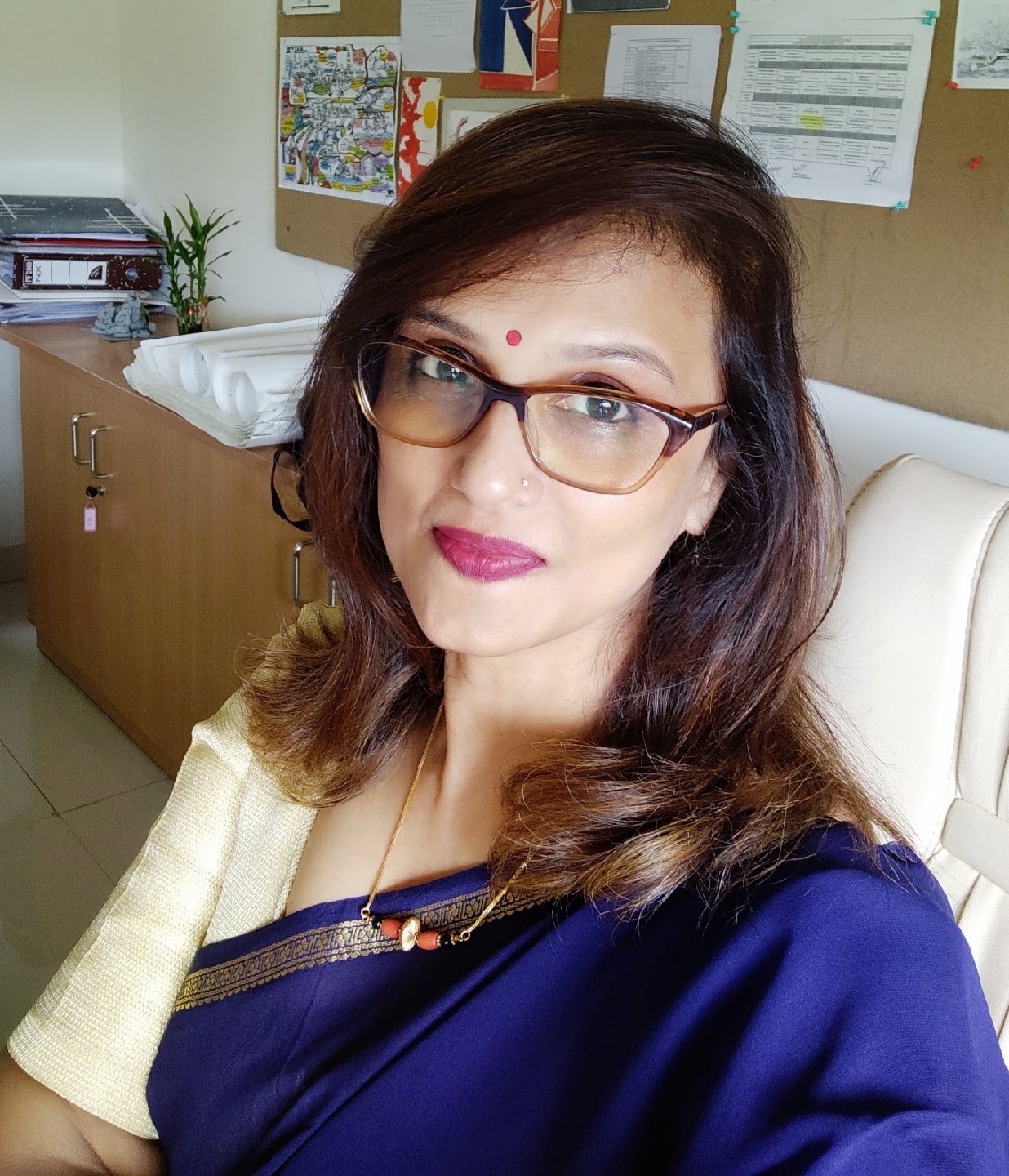
Director's Desk
The architectural profession can be seen as a developing and multi-disciplinary career. It is one of the major professions that affect the development of a country. It is the most influential professions in our society as it involves all aspects that affect the way in which our built environment is designed, constructed, and used thus affecting the user him/herself.
The holistic development of students and teachers is what we believe in and work for. We strive to achieve this by imbibing a unique value system, transparent work culture, excellent academic and physical environment conducive to learning, creativity & technology transfer. Our mandate is to generate, preserve and share knowledge for developing a vibrant society and we all have to ensure that there is no stone left unturned to equip the student of today for the challenges of life. We always put purpose before short term achievements, the vision before short-cuts. We also believe that nothing is impossible on this earth provided one makes an earnest attempt to proceed ahead with patience, dedication, and perseverance.
We mentor our students to imbibe our values and insights into the state of the art facility that nourishes and amplify the students’ talent to mould them into the masters of tomorrow.
I deeply appreciate the dedication and hard work of our team SSAUDP, which has made such massive progress possible. I also thank our students and their parents for bestowing their confidence in us. All this would not have been possible without the unstinted support of them.
Wishing you the best,
Dr. Gauri Shiurkar Director,
Symbiosis School of Architecture, Urban Development, and Planning
Dr. Gauri Shiurkar Director,
Symbiosis School of Architecture, Urban Development, and Planning
Events
School Achievements
Sakshi Sonigara
Presented paper in a Nation E- Conference- Skills and Architectural Education-A new Paradigm 2020
Prathith Puttaparthi
Under top 20 for Rookee Competition.
Nibha Chauhan
Poster Design for COVID 19
Shailee Gaud
Architectural Jounalist for an online site – Re- thinking the future
Pratibha Rane
Volume Zero International Tiny house design Competition (Organized by Volume Zero)

1
Graduated Students
1
Placed Students
Our Most
Popular Teachers
Popular Teachers
Lillian Walsh
Kelly Franklin
Hilary Ouse
Frequently Asked Questions
What is your program's duration?
B.Sc. (Data Science) – 3 Year Program. However, after each year there is an internship module of 8 credits. The detail of internship is as under
2 months after second semester (During First year)
2 months after Fourth semester (During Second year)
6 months after fifth semester (During third year)
M.Sc. (Data Science – 2-year program
What courses can I use to meet the program's prerequisites?
It could be better if you come with a basic background of below mentioned subjects/Domains.
Computer Programming:
- Problem solving, analysis and design of small-scale computational systems, and implementation using a procedural programming language.
- Python is the language most utilized in our program, however students are able to apply with backgrounds in other languages.
Statistics:
- Parameter estimation, introduction to the collection of data, elements of probabilistic modelling, basic probability computation techniques, discrete and continuous random variables and distributions, expectation and variance, central limit theorem, single-parameter confidence interval estimation, and exposure to any statistical software package.
Calculus or Linear Algebra:
- Calculus: single variable calculus, limits, derivatives and integrals of algebraic exponential, logarithmic and trigonometric functions play a central role, applications of differentiation, and fundamental theorem of calculus.
Linear Algebra: systems of linear equations, matrix algebra, linear transformations, and determinants.
Does M.Sc. (Data Science) have thesis component.
Yes, In the final year (4th semester) a thesis must be submitted along with one research paper published in web of science/Scopus indexed journal/conference.
Placement
Accordion #1
Lorem ipsum dolor sit amet, consectetur adipiscing elit. Ut elit tellus, luctus nec ullamcorper mattis, pulvinar dapibus leo.
Accordion #2
Lorem ipsum dolor sit amet, consectetur adipiscing elit. Ut elit tellus, luctus nec ullamcorper mattis, pulvinar dapibus leo.

Accordion #3
Lorem ipsum dolor sit amet, consectetur adipiscing elit. Ut elit tellus, luctus nec ullamcorper mattis, pulvinar dapibus leo.
Testimonail
Lorem ipsum dolor sit amet, consectetur adipiscing elit. Ut elit tellus, luctus nec ullamcorper mattis, pulvinar dapibus leo.
Frankie Kao
Web Design
Lorem ipsum dolor sit amet, consectetur adipiscing elit. Ut elit tellus, luctus nec ullamcorper mattis, pulvinar dapibus leo.
Frankie Kao
Web Design
Lorem ipsum dolor sit amet, consectetur adipiscing elit. Ut elit tellus, luctus nec ullamcorper mattis, pulvinar dapibus leo.